Unsupervised learning: Gaussian mixture models


SURE 2025

Department of Statistics & Data Science
Carnegie Mellon University

Background

Previously: clustering

Goal: partition observations into subgroups/cluster, where points within a cluster are more “similar” than points between clusters

Classification vs clustering

Classification

  • Supervised learning

  • We are given labeled (categorical) data

  • Focus on generalizability (i.e. build a classifier that performs well on predicting unseen/test data)

Clustering

  • Unsupervised learning

  • We are only given the data points (with no labels)

  • Focus on finding interesting subgroups/structure in the data

Previously: clustering

  • Previous methods: \(k\)-means clustering and hierarchical clustering
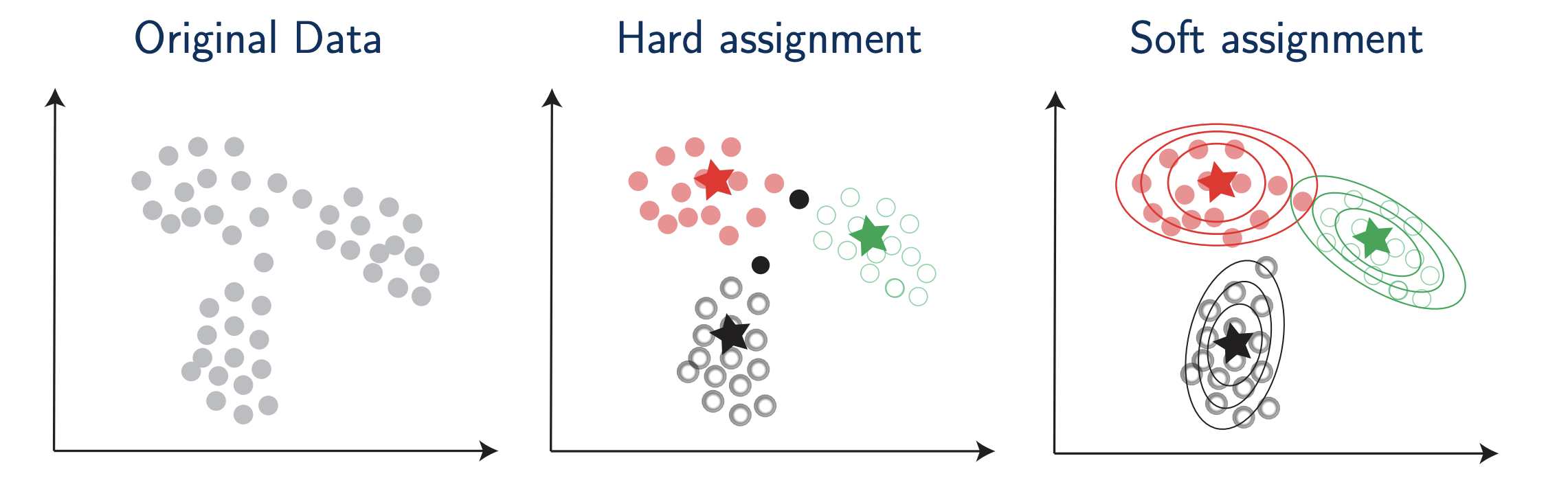
  • Output hard assignments, strictly assigning observations to only one cluster
  • What about soft/fuzzy assignments and uncertainty in the clustering results?

    • Assigns each observation a probability of belonging to a cluster

    • Incorporate statistical modeling into clustering

  • We want to estimate the density of the observations in some way that allows us to extract clusters

Motivating figure


Model-based (parametric) clustering

  • Moves beyond hard cluster assignments and allows for flexible and probabilistic soft assignments
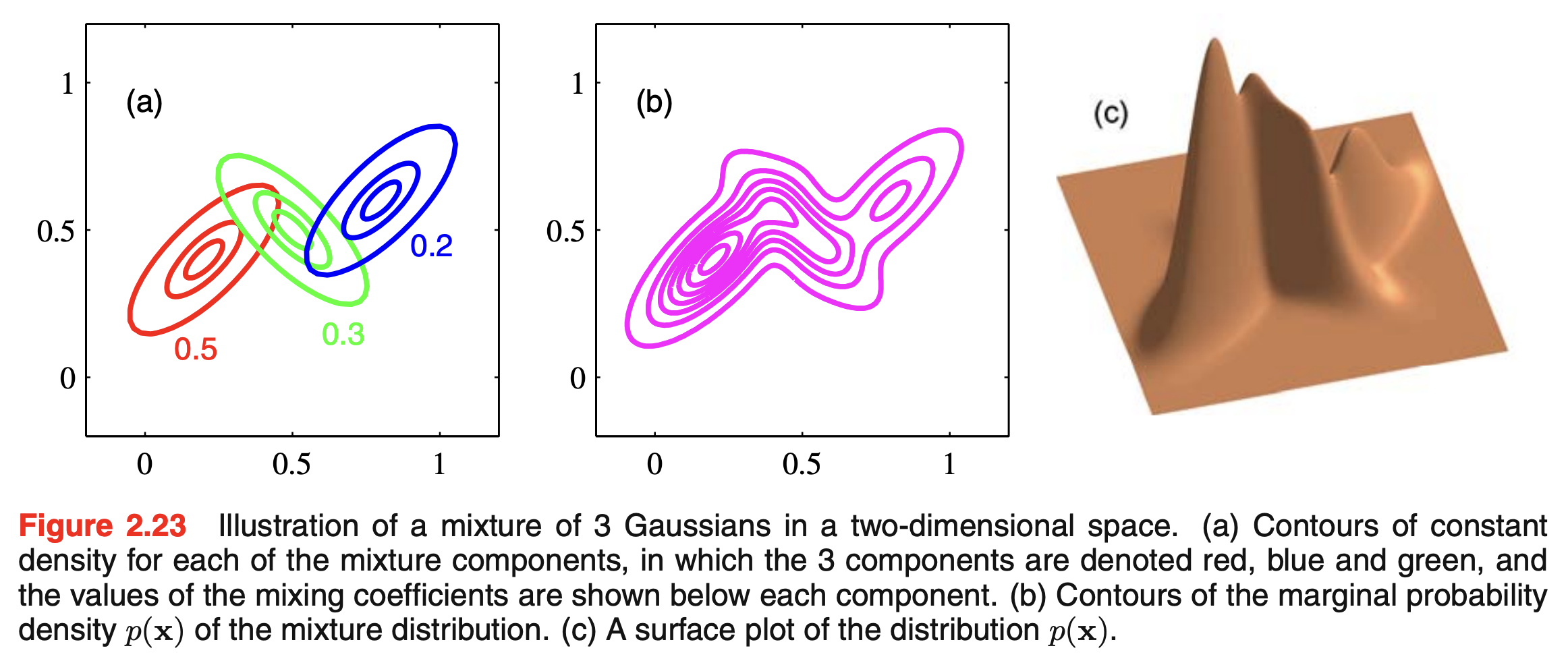
  • Key idea: data are considered as coming from a mixture of underlying probability distributions
  • Assume data are sample from a population with underlying density; estimate density, use its characteristics to determine clustering structure
  • Most popular method: Gaussian mixture model (GMM)

    • Each observation is assumed to be distributed as one of \(K\) multivariate normal distributions

    • \(K\) is the number of clusters/components

  • Other variations: skewed normal, t-distributions, beta, etc. (as long as it can be estimated)

Mixture models

Mixtures of Gaussians in 1D

  • We would like to model the density of the data points, but due to the apparent multi-modality, a single Gaussian distribution would not be appropriate

  • There seems to be two separate underlying regimes, so instead we model the density as a mixture of Gaussians
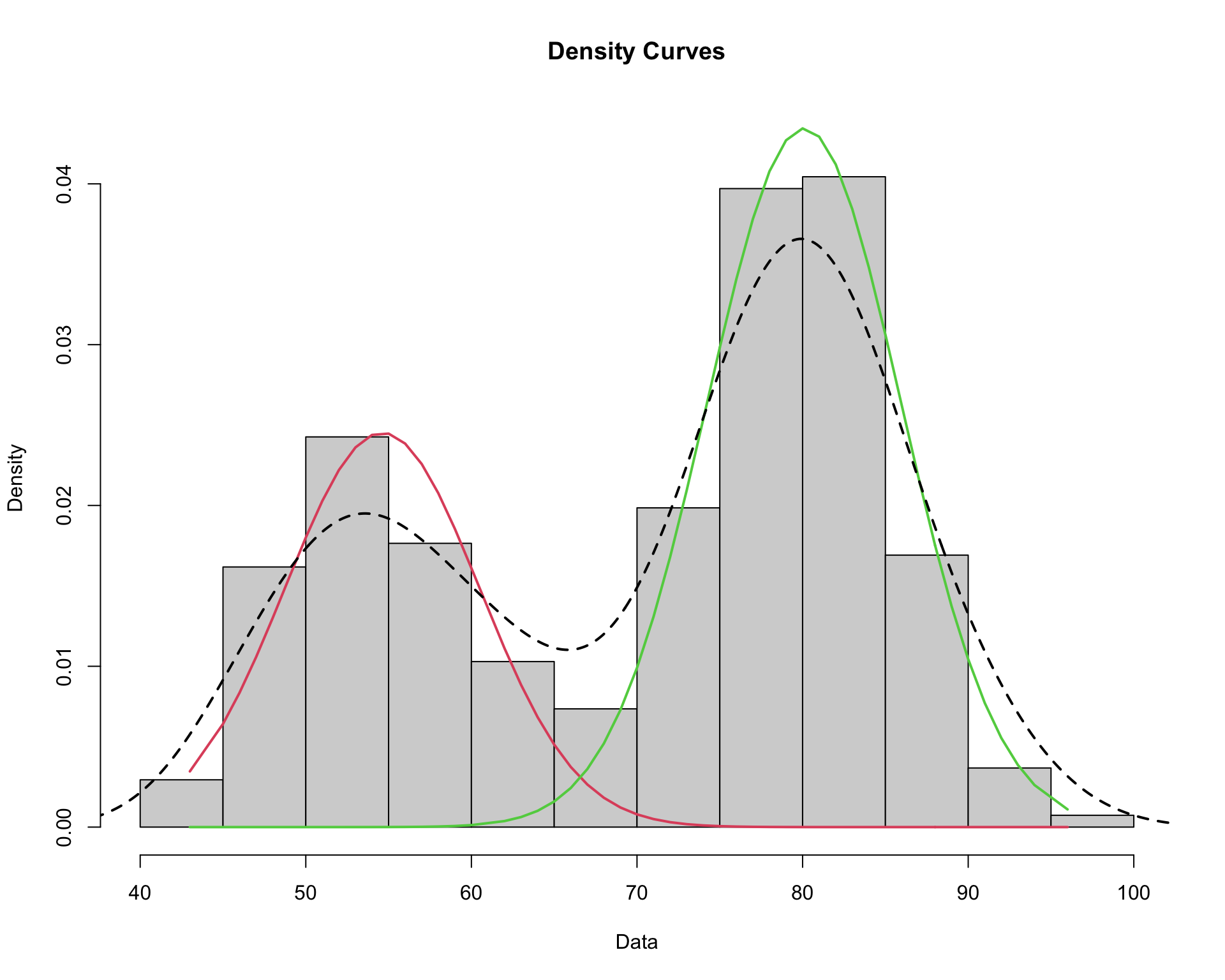
number of iterations= 29 

Mixtures of Gaussians in 2D


Mixture models in general

We assume that each population subgroup (cluster) is represented by some density \(f_k(x; \theta_k)\) and the population density \(f(x)\) is a weighted combination (i.e. mixture) of the subgroup densities

\[\displaystyle f(x) = \sum_{k=1}^K \tau_k f_k(x; \theta_k)\]

where

  • \(\tau_k\): mixture weights, with \(\tau_k \ge 0\) and \(\sum_{k=1}^K \tau_k = 1\)

  • \(f_k\): mixture components

  • \(K\): total number of mixture components (clusters)

We need to

  • choose the number of components (clusters) \(K\) and the weights \(\tau_k\)

  • estimate the parameters \(\theta_k\) of the mixture component densities \(f_k\)

Gaussian mixture models

  • Assume a parametric mixture model (with parameters \(\theta_k\) for the \(k\)-th component)

\[f(x) = \sum_{k=1}^K \tau_k f_k(x; \theta_k)\]

  • Most often the mixture component densities are assumed to be Gaussian with parameters \(\theta_k = \{\mu_k, \Sigma_k\}\)
  • The covariance matrices \(\Sigma_k\) characterize the clusters

    • volume: size of the clusters (number of observations)

    • shape: direction of variance (which variables display more variance)

    • orientation: aligned with axes (low covariance) versus tilted (due to relationships between variables)

  • We can choose each of these values (volume/shape/orientation) to be the same or different among clusters

Covariance constraints

3 letters in model name denote (in order) the volume, shape, and orientation across clusters
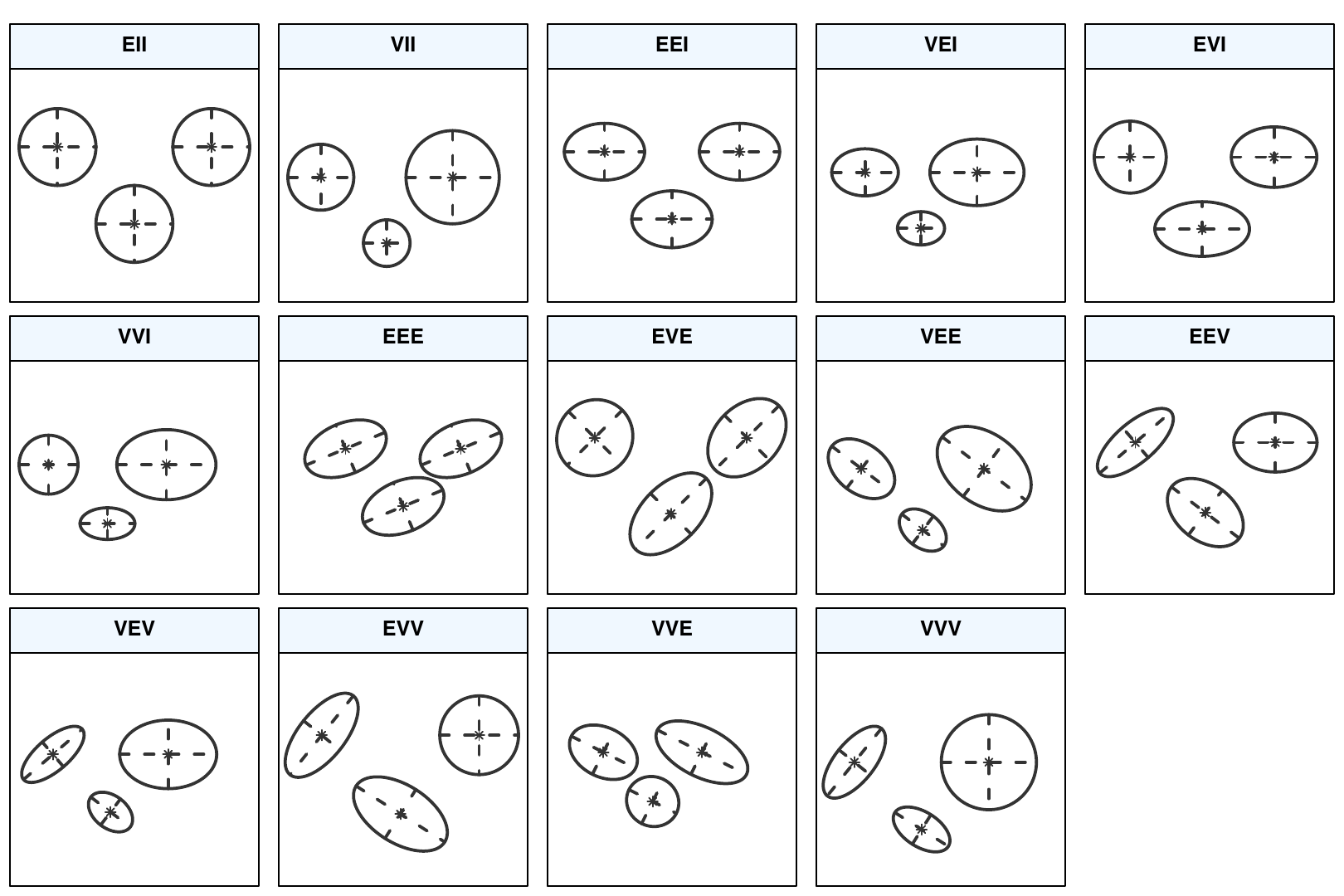
Covariance constraints: summary table

Model Distribution Volume Shape Orientation
EII Spherical Equal Equal
VII Spherical Variable Equal
EEI Diagonal Equal Equal Coordinate axes
VEI Diagonal Variable Equal Coordinate axes
EVI Diagonal Equal Variable Coordinate axes
VVI Diagonal Variable Variable Coordinate axes
EEE Ellipsoidal Equal Equal Equal
EVE Ellipsoidal Equal Variable Equal
VEE Ellipsoidal Variable Equal Equal
VVE Ellipsoidal Variable Variable Equal
EEV Ellipsoidal Equal Equal Variable
VEV Ellipsoidal Variable Equal Variable
EVV Ellipsoidal Equal Variable Variable
VVV Ellipsoidal Variable Variable Variable

Model fitting and selection

  • Model fitting is done using an Expectation-Maximization (EM) algorithm
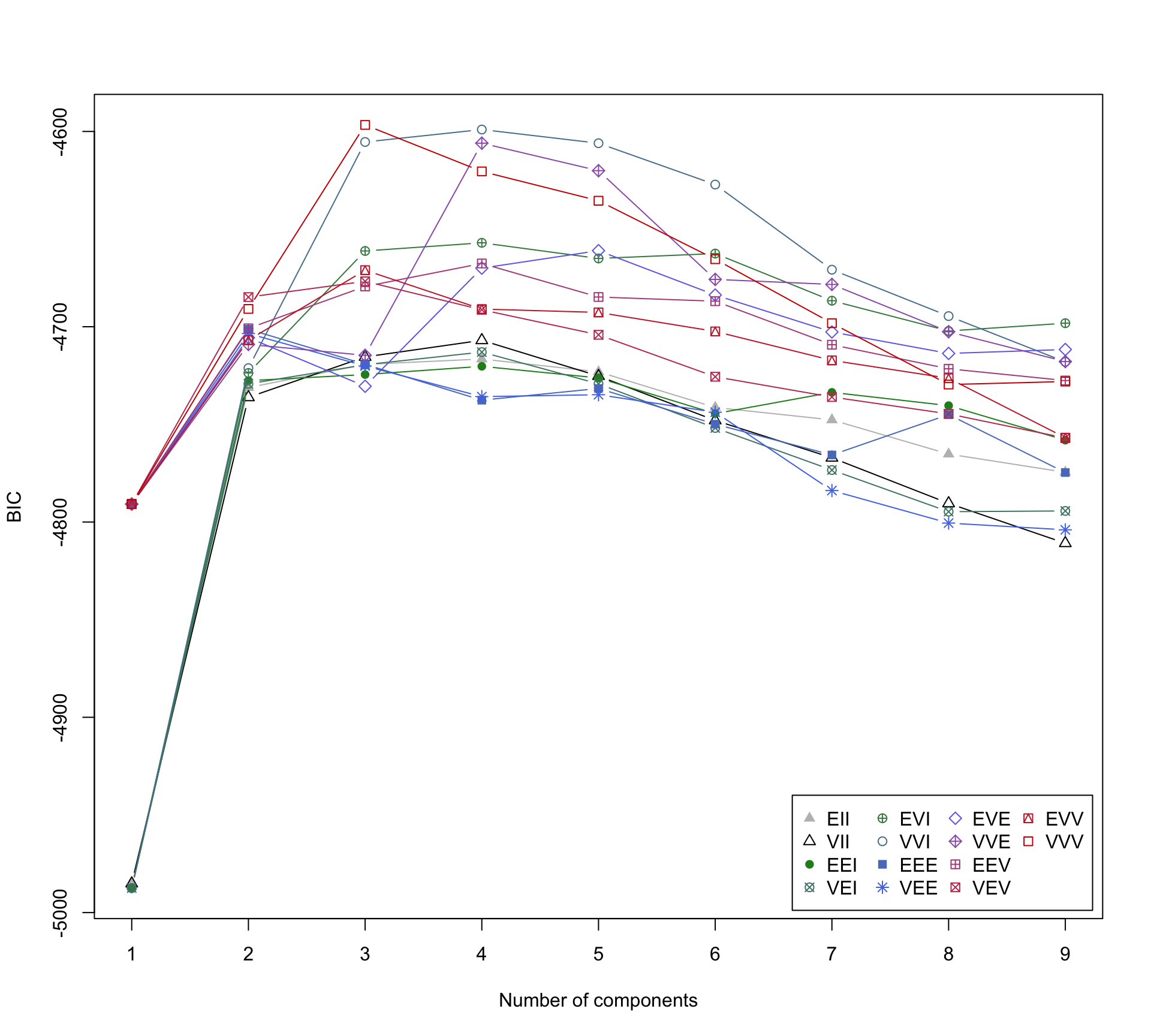
  • Since this is a statistical model, we can choose the number of components/clusters \(K\) and covariance constraint using the Bayesian Information Criterion (BIC) \[\text{BIC} = 2\log L(x \mid \theta) - m\log n \,,\] where

    • \(L(x \mid \theta)\): likelihood of the considered model

    • \(m\): number of parameters (e.g. VVV has the most parameters)

    • \(n\): number of observations

  • The BICs are calculated for all candidate models (different combinations of \(K\) and covariance constraints), and we select one final model that gives the optimum BIC value

Expectation-Maximization (EM) algorithm

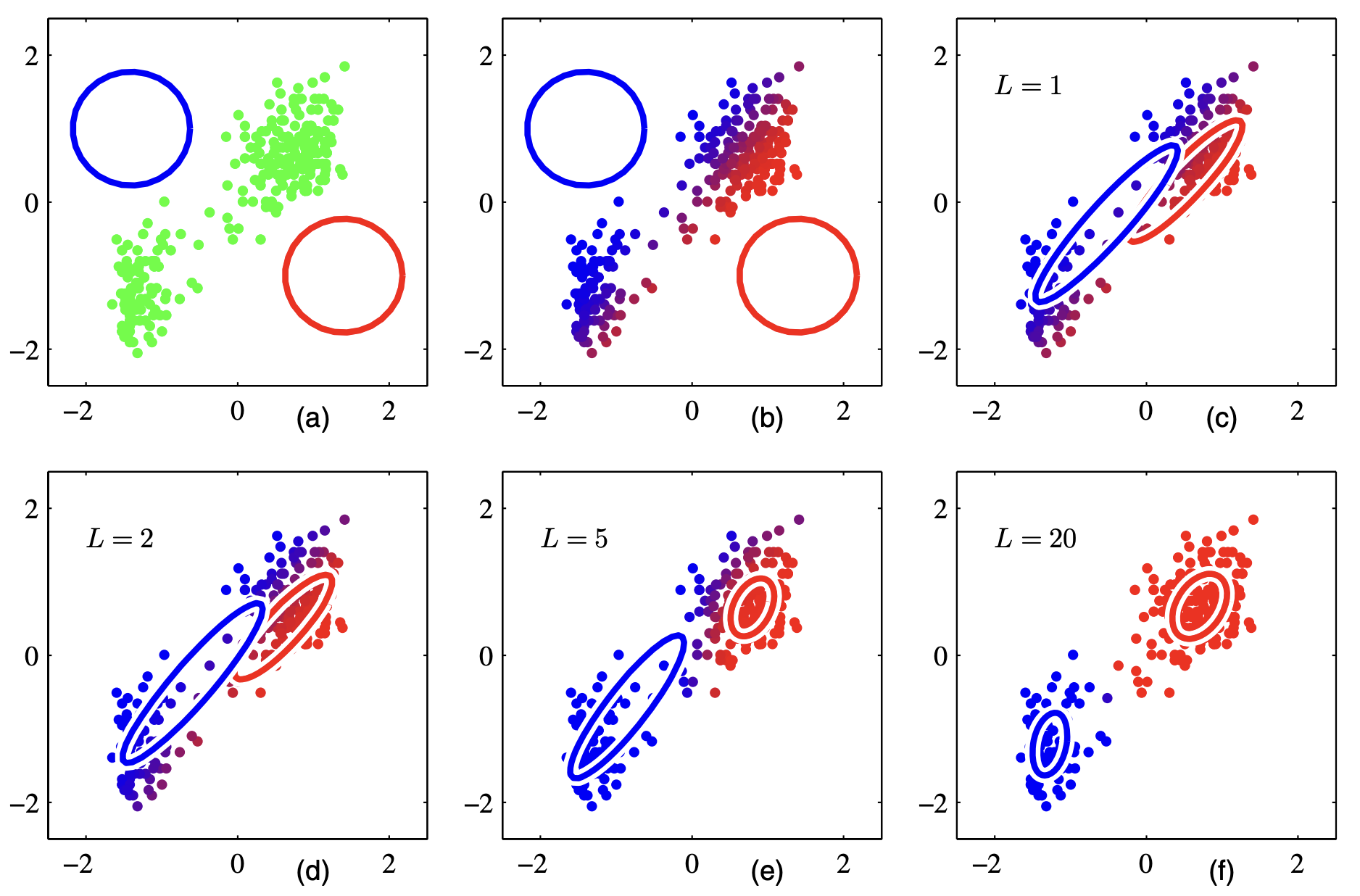
  • Goal: Given a GMM, we want to maximize the likelihood function with respect to the parameters (means & covariances of the components and mixture weights)
  • First, initialize the model parameters (\(\mu_k, \Sigma_k, \tau_k\)) randomly
  • Then, alternate between the following two steps (keep repeating until convergence)

    • E-step: estimate \(\gamma_{ik}\), the soft assignments of observation \(i\) belonging to component/cluster \(k\)

    • M-step: re-estimate the model parameters

  • Output: \(\hat{\gamma}_{ik}\) are the final estimated soft assignments of observation \(i\) belonging to cluster \(k\)

    • We can assign observation \(i\) to a cluster with the largest \(\hat{\gamma}_{ik}\)

    • We also get the cluster assignment uncertainty of \(\displaystyle 1 - \max_k \hat{\gamma}_{ik}\)

EM algorithm example

Is this familiar?

  • In GMMs, we’re essentially

    • guessing how much we think each Gaussian component generates each observation

    • pretending to know the parameters to perform maximum likelihood estimation

  • This resembles the \(k\)-means algorithm!

    • The cluster centroids are chosen at random, and then recomputed/updated

    • This is repeated until the cluster assignments stop changing

  • Instead of assigning each point to a single cluster, we “softly” assign them so they contribute fractionally to each cluster

Example

Data: NBA player statistics per 100 possessions (2023-24 regular season)

library(tidyverse)
theme_set(theme_light())
nba_players <- read_csv("https://raw.githubusercontent.com/36-SURE/2025/main/data/nba_players_2024.csv")
glimpse(nba_players)
Rows: 452
Columns: 33
$ rk         <dbl> 1, 2, 3, 4, 5, 6, 7, 9, 10, 11, 12, 13, 14, 16, 17, 19, 20,…
$ player     <chr> "Precious Achiuwa", "Bam Adebayo", "Ochai Agbaji", "Santi A…
$ pos        <chr> "PF-C", "C", "SG", "PF", "SG", "SG", "C", "PG", "PF", "PF",…
$ age        <dbl> 24, 26, 23, 23, 25, 28, 25, 25, 30, 29, 31, 23, 26, 23, 25,…
$ tm         <chr> "TOT", "MIA", "TOT", "MEM", "MIN", "PHO", "CLE", "NOP", "MI…
$ g          <dbl> 74, 71, 78, 61, 82, 75, 77, 56, 79, 73, 34, 81, 50, 75, 55,…
$ gs         <dbl> 18, 71, 28, 35, 20, 74, 77, 0, 10, 73, 0, 0, 50, 75, 55, 1,…
$ mp         <dbl> 1624, 2416, 1641, 1618, 1921, 2513, 2442, 1028, 1782, 2567,…
$ fg         <dbl> 7.2, 10.9, 5.2, 7.5, 6.1, 6.6, 10.5, 6.8, 5.5, 15.7, 5.0, 9…
$ fga        <dbl> 14.4, 21.0, 12.7, 17.2, 13.8, 13.3, 16.6, 16.5, 12.0, 25.6,…
$ fgpercent  <dbl> 0.501, 0.521, 0.411, 0.435, 0.439, 0.499, 0.634, 0.412, 0.4…
$ x3p        <dbl> 0.8, 0.3, 1.8, 3.2, 3.4, 4.0, 0.0, 3.7, 0.3, 0.6, 0.0, 2.5,…
$ x3pa       <dbl> 3.0, 0.9, 6.2, 9.2, 8.6, 8.6, 0.1, 9.9, 1.3, 2.3, 0.3, 7.5,…
$ x3ppercent <dbl> 0.268, 0.357, 0.294, 0.349, 0.391, 0.461, 0.000, 0.377, 0.2…
$ x2p        <dbl> 6.4, 10.6, 3.4, 4.3, 2.7, 2.6, 10.5, 3.1, 5.2, 15.0, 5.0, 6…
$ x2pa       <dbl> 11.4, 20.1, 6.5, 8.0, 5.2, 4.6, 16.4, 6.6, 10.7, 23.3, 9.0,…
$ x2ppercent <dbl> 0.562, 0.528, 0.523, 0.534, 0.517, 0.570, 0.638, 0.464, 0.4…
$ ft         <dbl> 2.1, 6.0, 1.1, 1.6, 1.3, 2.5, 4.7, 1.7, 2.7, 9.6, 0.0, 4.9,…
$ fta        <dbl> 3.4, 8.0, 1.6, 2.6, 1.7, 2.9, 6.4, 2.5, 3.8, 14.6, 0.6, 5.9…
$ ftpercent  <dbl> 0.616, 0.755, 0.661, 0.621, 0.800, 0.878, 0.742, 0.673, 0.7…
$ orb        <dbl> 5.9, 3.3, 2.2, 2.2, 0.9, 0.9, 4.9, 1.2, 1.7, 3.7, 2.2, 1.7,…
$ drb        <dbl> 9.1, 11.9, 4.2, 8.5, 3.4, 4.8, 11.5, 4.9, 5.9, 12.1, 1.9, 6…
$ trb        <dbl> 14.9, 15.2, 6.4, 10.6, 4.3, 5.7, 16.4, 6.1, 7.6, 15.7, 4.0,…
$ ast        <dbl> 3.0, 5.7, 2.4, 4.2, 5.2, 4.4, 4.2, 5.6, 9.2, 8.9, 5.3, 6.4,…
$ stl        <dbl> 1.4, 1.7, 1.4, 1.3, 1.6, 1.3, 1.1, 2.8, 2.0, 1.6, 2.2, 1.7,…
$ blk        <dbl> 2.1, 1.4, 1.3, 1.6, 1.1, 0.9, 1.6, 0.7, 1.3, 1.5, 1.2, 1.0,…
$ tov        <dbl> 2.5, 3.3, 1.9, 2.1, 2.0, 1.8, 2.4, 1.9, 2.5, 4.7, 4.3, 3.4,…
$ pf         <dbl> 4.4, 3.3, 3.4, 2.7, 3.7, 3.1, 3.0, 4.2, 3.6, 3.9, 7.4, 4.8,…
$ pts        <dbl> 17.3, 28.2, 13.4, 19.8, 16.9, 19.7, 25.7, 18.9, 14.0, 41.6,…
$ x          <lgl> NA, NA, NA, NA, NA, NA, NA, NA, NA, NA, NA, NA, NA, NA, NA,…
$ ortg       <dbl> 114, 115, 102, 109, 115, 130, 131, 112, 114, 126, 92, 110, …
$ drtg       <dbl> 112, 109, 121, 114, 111, 117, 110, 112, 109, 112, 117, 111,…
$ link       <chr> "/players/a/achiupr01.html", "/players/a/adebaba01.html", "…

Implementation with mclust package

Select the model and number of clusters

Use Mclust() function to search over 1 to 9 clusters (default) and the different covariance constraints (i.e. models)

library(mclust)
# x3pa: 3pt attempts per 100 possessions
# trb: total rebounds per 100 possessions
nba_mclust <- nba_players |> 
  select(x3pa, trb) |> 
  Mclust()
summary(nba_mclust)
---------------------------------------------------- 
Gaussian finite mixture model fitted by EM algorithm 
---------------------------------------------------- 

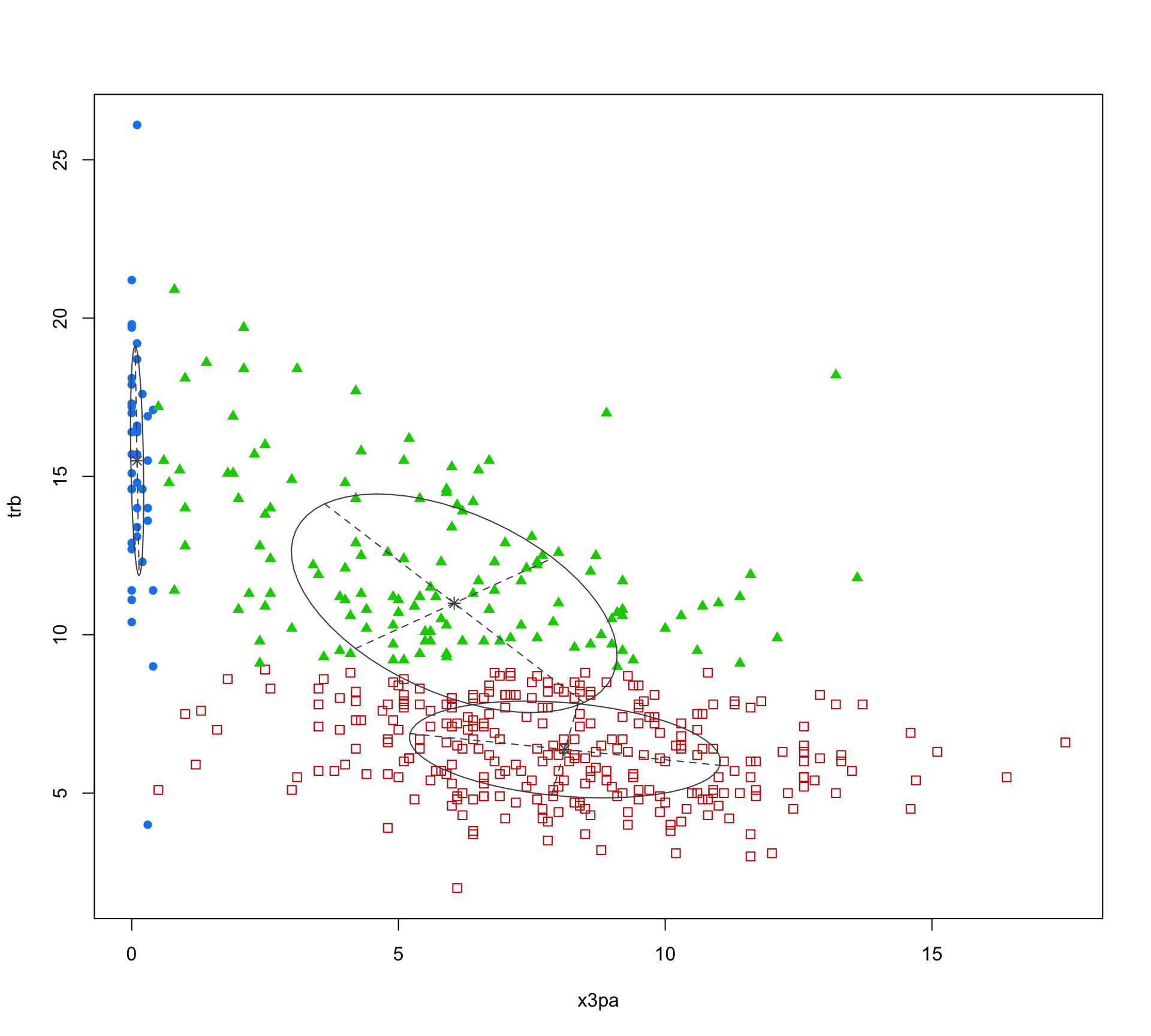
Mclust VVV (ellipsoidal, varying volume, shape, and orientation) model with 3
components: 

 log-likelihood   n df      BIC       ICL
      -2246.359 452 17 -4596.65 -4739.919

Clustering table:
  1   2   3 
 40 280 132 

View clustering summary

library(broom)
nba_mclust |> 
  tidy()  
# A tibble: 3 × 5
  component  size proportion mean.x3pa mean.trb
      <int> <int>      <dbl>     <dbl>    <dbl>
1         1    40     0.0822     0.101    15.5 
2         2   280     0.535      8.12      6.38
3         3   132     0.382      6.04     11.0 

View clustering assignments

nba_mclust |> 
  augment() |> 
  ggplot(aes(x = x3pa, y = trb, color = .class, size = .uncertainty)) +
  geom_point(alpha = 0.6) +
  ggthemes::scale_color_colorblind()

Display the BIC for each model and number of clusters

nba_mclust |> 
  plot(what = "BIC", 
       legendArgs = list(x = "bottomright", ncol = 4))
nba_mclust |> 
  plot(what = "classification")
How do the cluster assignments compare to the positions?

Two-way table to compare the clustering assignments with player positions

(What’s the way to visually compare the two labels?)

table("Clusters" = nba_mclust$classification, "Positions" = nba_players$pos)
        Positions
Clusters  C C-PF PF PF-C PF-SF PG PG-SG SF SF-PF SF-SG SG SG-PG
       1 34    2  3    0     0  1     0  0     0     0  0     0
       2  3    0 33    0     1 78     4 70     1     1 88     1
       3 43    1 53    1     0  3     0 22     1     0  8     0

Takeaway: positions tend to fall within particular clusters

What about the cluster probabilities?

nba_player_probs <- nba_mclust$z
colnames(nba_player_probs) <- str_c("cluster", 1:3)

nba_player_probs <- nba_player_probs |>
  as_tibble() |>
  mutate(player = nba_players$player) |>
  pivot_longer(!player, names_to = "cluster", values_to = "prob")

nba_player_probs |>
  ggplot(aes(prob)) +
  geom_histogram() +
  facet_wrap(~ cluster)
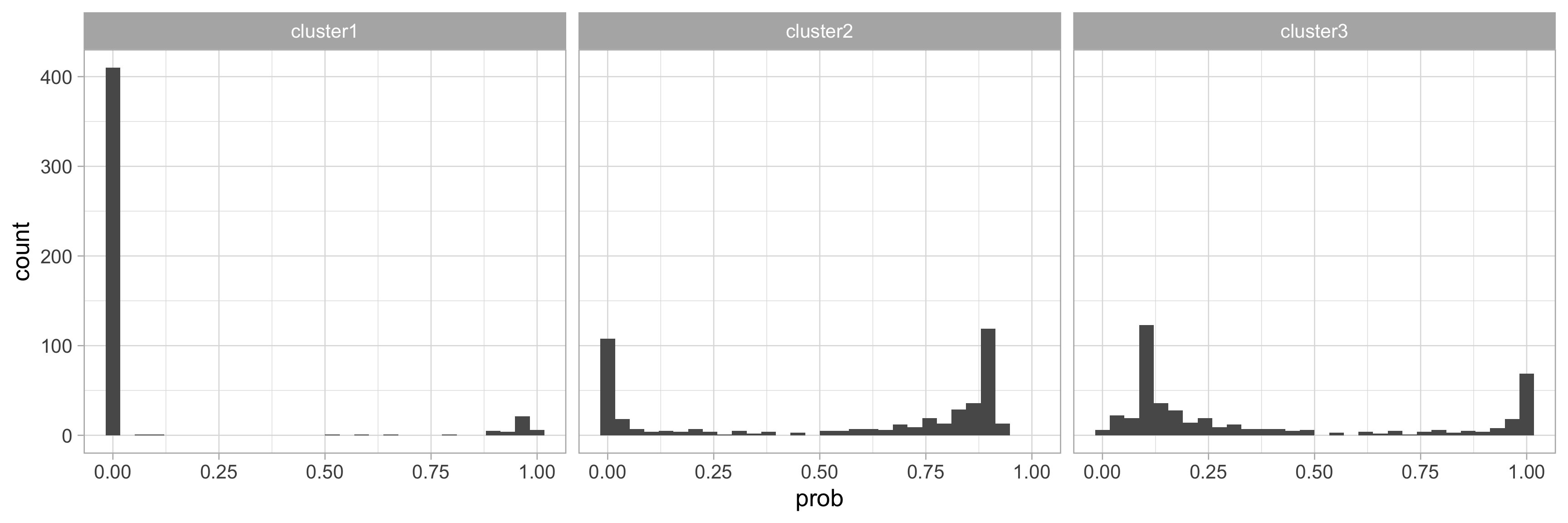
Which players have the highest uncertainty?


nba_players |>
  mutate(cluster = nba_mclust$classification,
         uncertainty = nba_mclust$uncertainty) |> 
  group_by(cluster) |>
  slice_max(uncertainty, n = 5) |> 
  mutate(player = fct_reorder(player, uncertainty)) |> 
  ggplot(aes(x = uncertainty, y = player)) +
  geom_point(size = 3) +
  facet_wrap(~ cluster, scales = "free_y", nrow = 3)

Challenges and resources