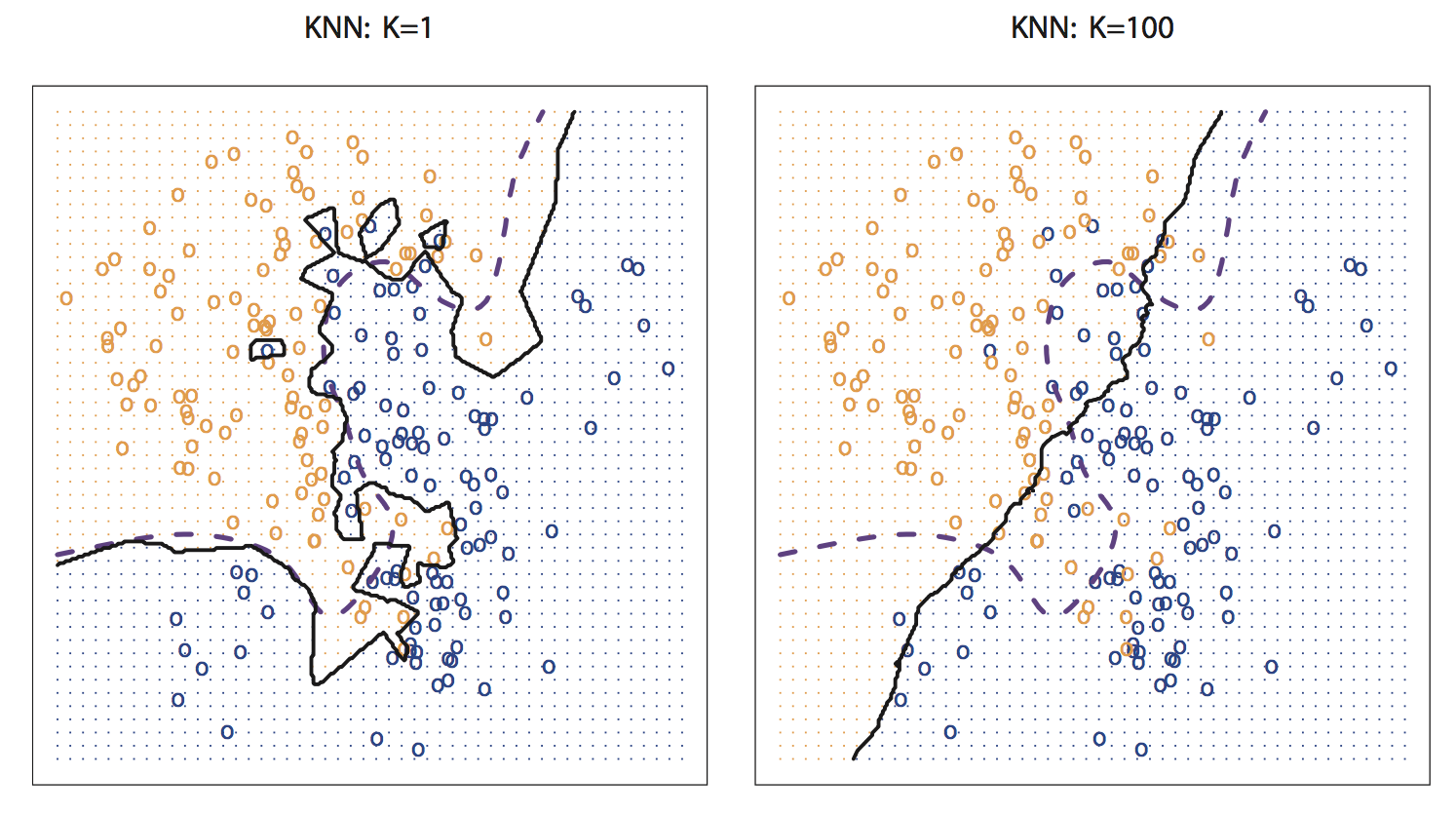
Find the \(k\) data points closest to an observation \(x\), use these to make predictions
Take the average value of the response over the \(k\) nearest neighbors
\(k\)-NN classification: most common class among the \(k\) nearest neighbors (“majority vote”)
\(k\)-NN regression: average of the values of \(k\) nearest neighbors
Recall: bias-variance tradeoff

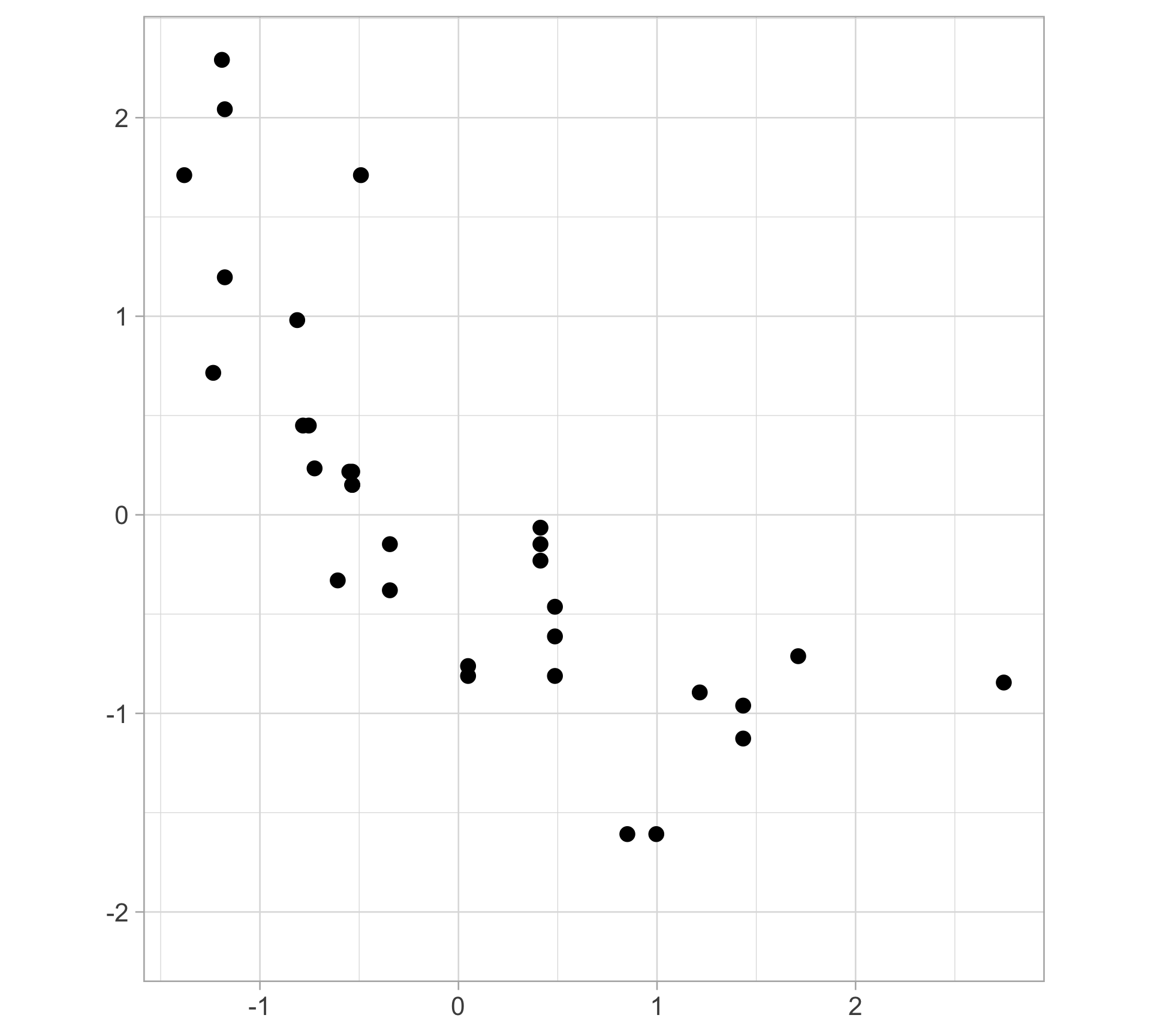
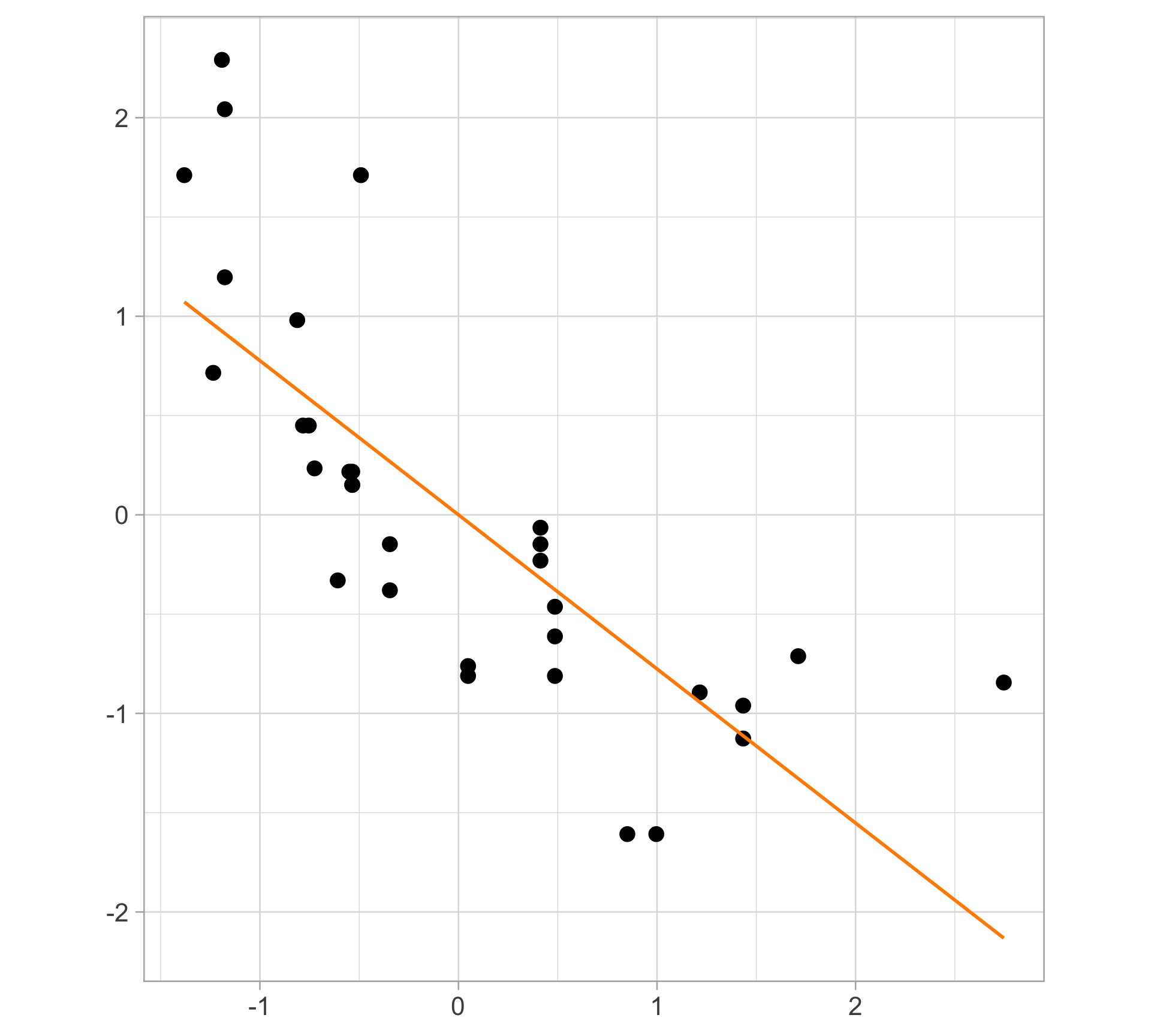
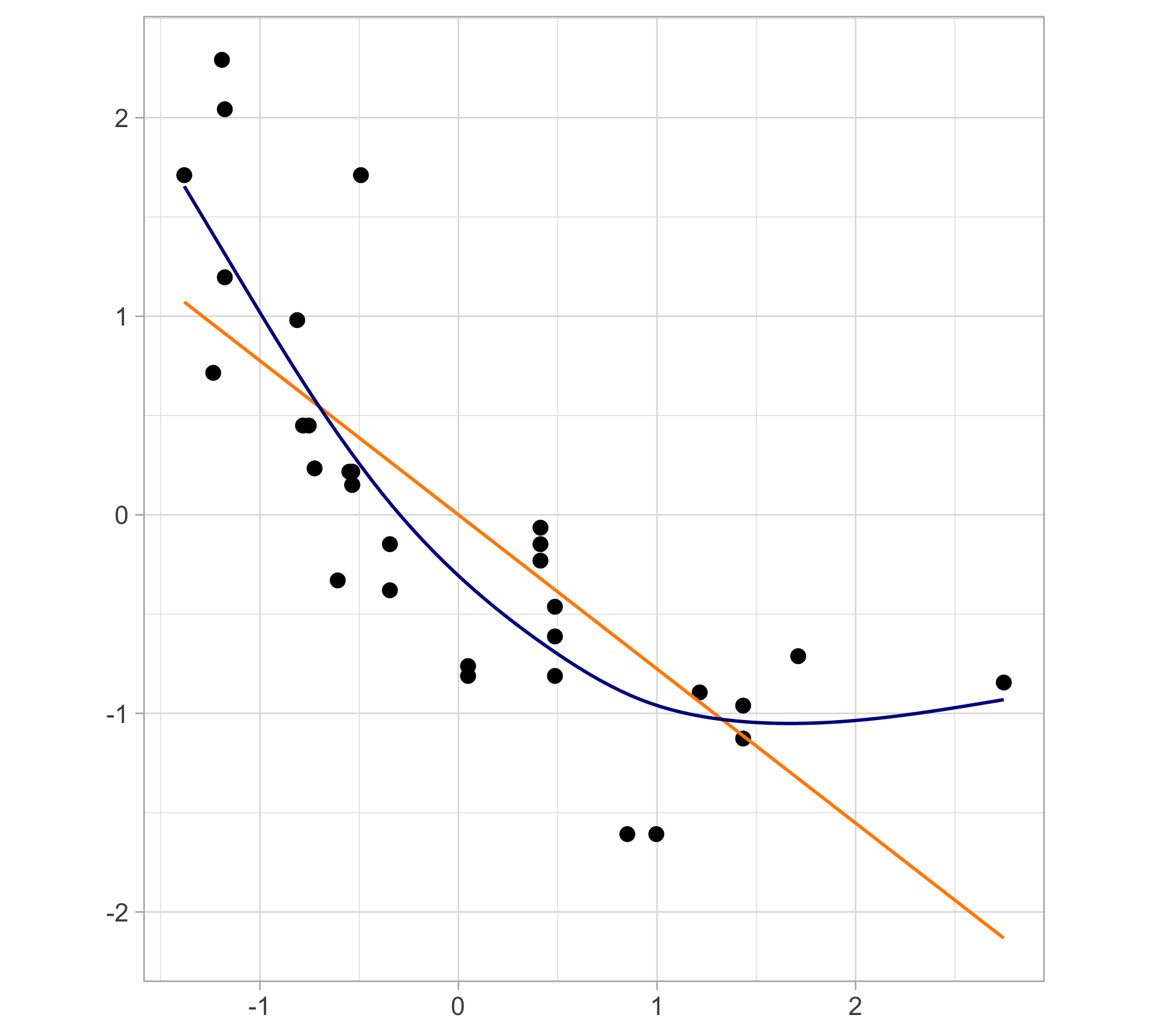
What if it’s not linear?
splines
local regression
generalized additive models
wavelets
Resources
Book: Generalized Additive Models by Simon Wood
GAM resources GitHub repository
What if we replace the linear predictor by additive smooth functions of the explanatory variables?
Entering generalized additive models (GAMs)
relax the restriction that the relationship must be a simple weighted sum
instead assume that the response can be modeled by a sum of arbitrary functions of each predictor
\[g(\mathbb E[Y \mid X = x]) = \beta_0 + s_1(x_1) + s_2(x_2) + \dots + s_p(x_p)\]
A disadvantage of GAMs/smoothing methods is the loss of interpretability
How do we interpret the effect of a predictor on the response?
How do we perform inferences for those effects?

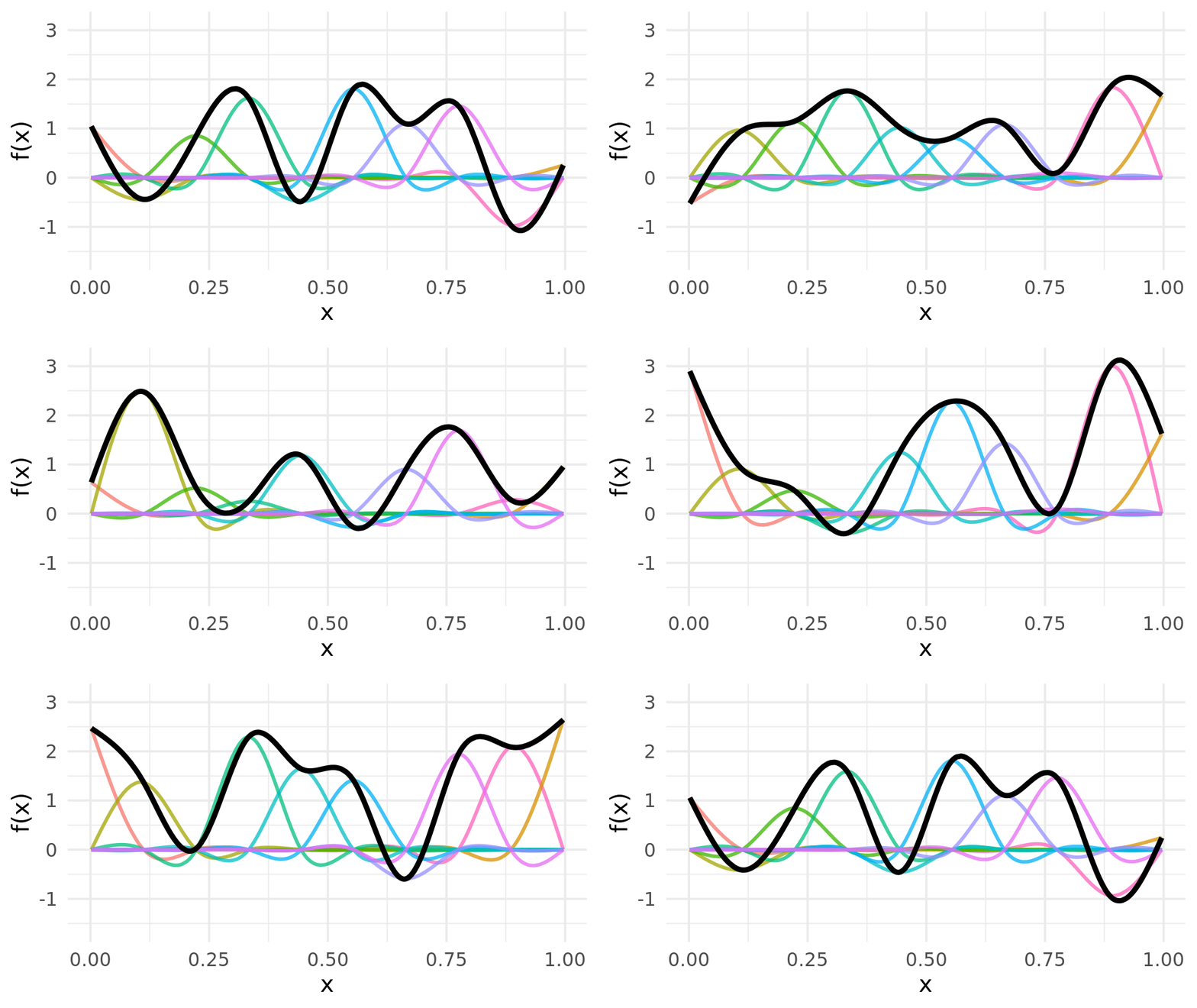
\[\displaystyle s(x) = \sum_{k=1}^K \beta_k b_k(x)\]
\[y_i \sim \mathcal{N}(\mu_i, \sigma^2)\] \[\mu_i = \beta_0 + \beta_1 x_{i} + \beta_2 x^2_{1i} + \cdots + \beta_j x^j_{i}\]
In the polynomial models we use a polynomial basis expansion of \(x\)
Use smooth function \(s(x)\) to predict \(y\), control smoothness directly by minimizing the spline objective function
\[\sum_{i=1}^n (y_i - s(x_i))^2 + \lambda \int s''(x)^2dx\]
\[= \text{fit data} + \text{impose smoothness}\]
\[\longrightarrow \text{model fit} = \text{likelihood} - \lambda \cdot \text{wiggliness}\]
\[\text{minimize }\sum_{i=1}^n (y_i - s(x_i))^2 + \lambda \int s''(x)^2dx\]
Second term: roughness penalty, controls how wiggly \(s(x)\) is via tuning parameter \(\lambda \ge 0\)
Balances the accuracy of the fit and the flexibility of the function
The smaller \(\lambda\), the more wiggly the function
As \(\lambda \rightarrow \infty\), \(s(x)\) becomes linear
Goal: Estimate the smoothing spline \(\hat{s}(x)\) that balances the tradeoff between the model fit and wiggliness
Remember: Goldilocks principle

A framework to model flexible nonlinear relationships
Use little functions (basis functions) to make big functions (smooths)
The predictor matrix has columns for each basis function, evaluated at each observation
Use a penalty to trade off model fit and wiggliness
Need to make sure the smooths are wiggly enough
Data available via the pybaseball library in python
Statcast data include pitch-level information, pulled from baseballsavant.com
Example data collected for the entire month of May 2024
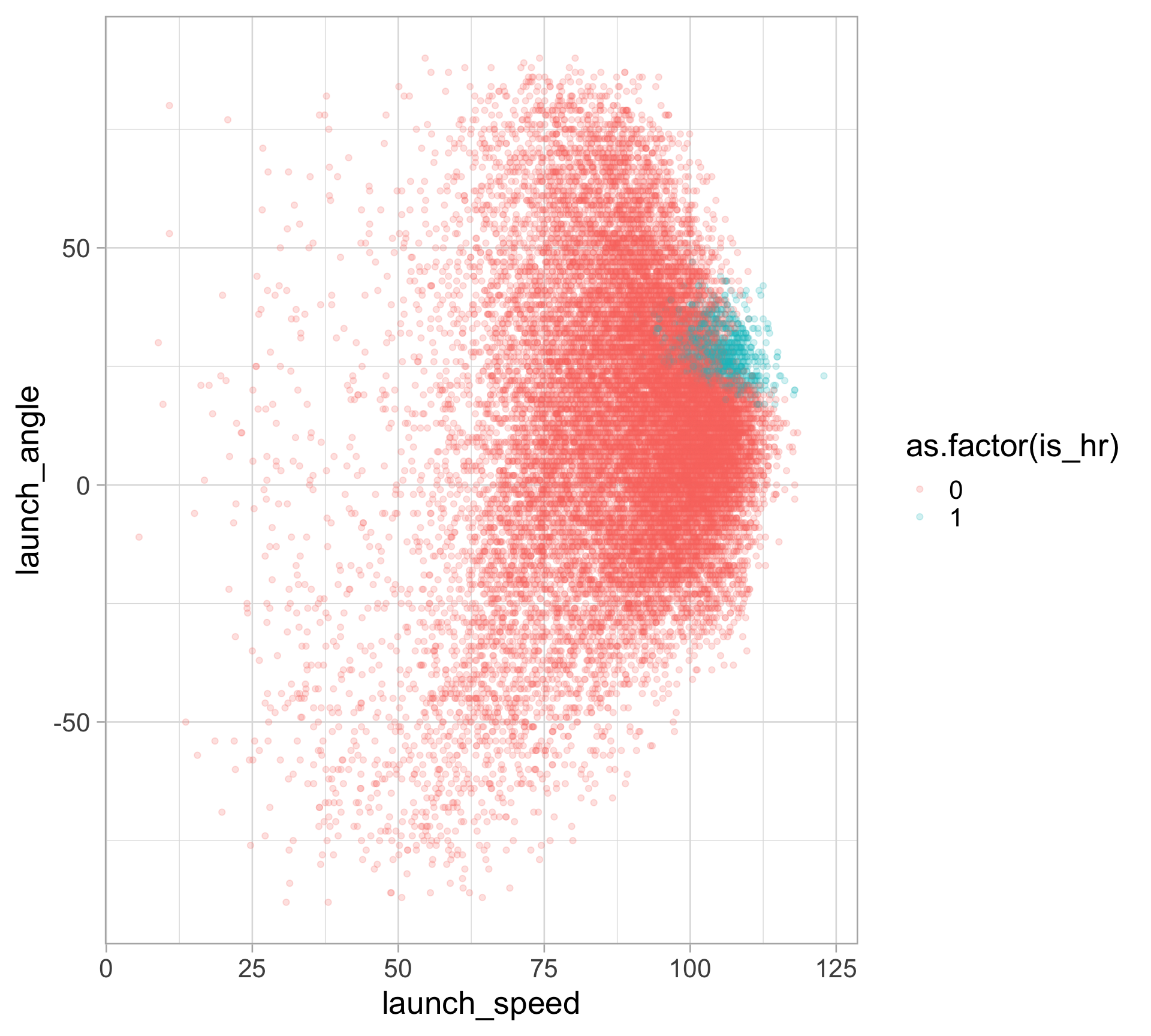
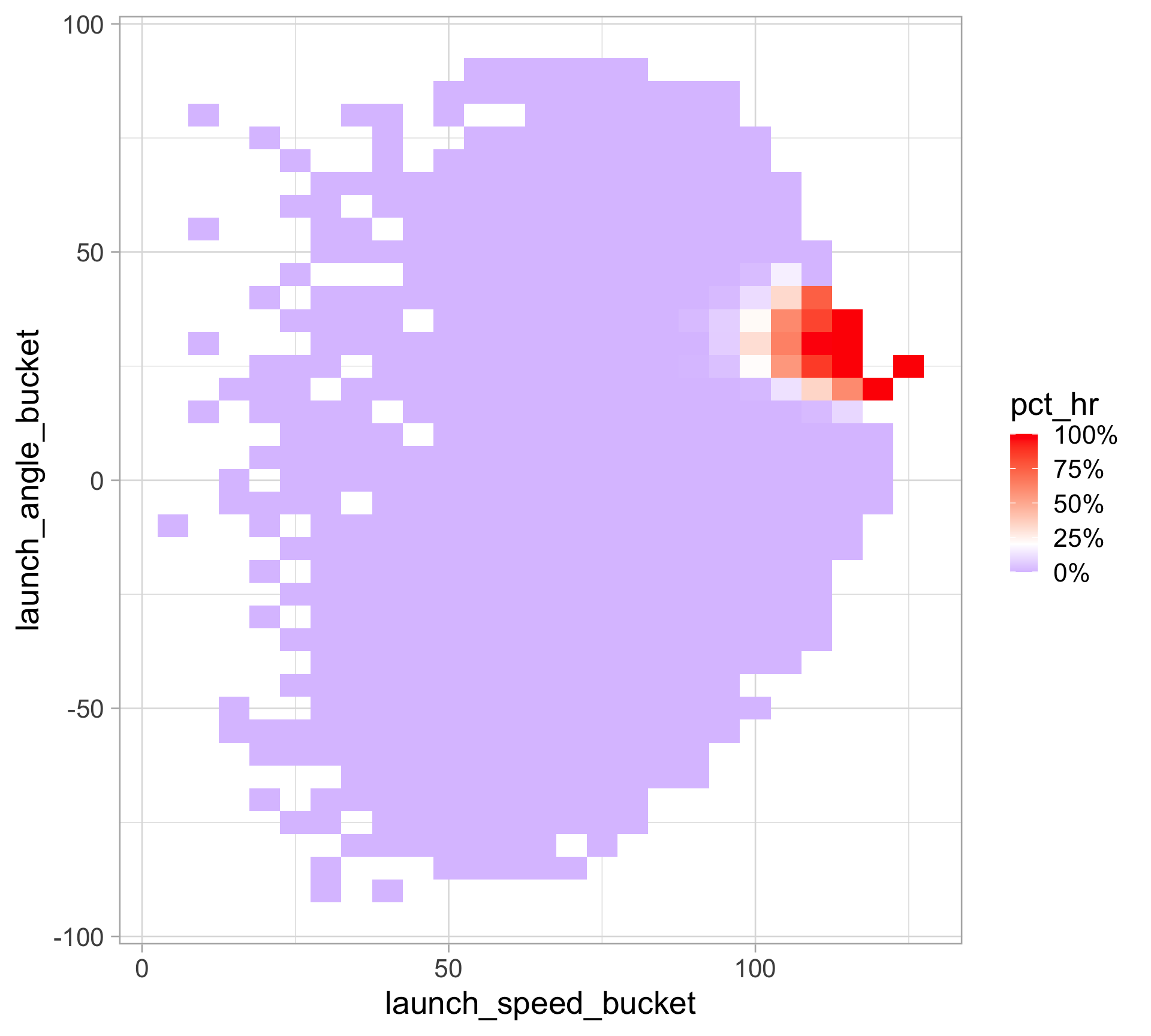
HRs are relatively rare and confined to one area of this plot
There is a sweet spot of launch_angle (mid-way ish) and launch_speed (relatively high) where almost all HRs occur
batted_balls |>
group_by(
launch_angle_bucket = round(launch_angle * 2, -1) / 2,
launch_speed_bucket = round(launch_speed * 2, -1) / 2
) |>
summarize(hr = sum(is_hr == 1),
n = n()) |>
ungroup() |>
mutate(pct_hr = hr / n) |>
ggplot(aes(x = launch_speed_bucket,
y = launch_angle_bucket,
fill = pct_hr)) +
geom_tile() +
scale_fill_gradient2(labels = scales::percent_format(),
low = "blue",
high = "red",
midpoint = 0.2)
launch_speed and launch_angle \[
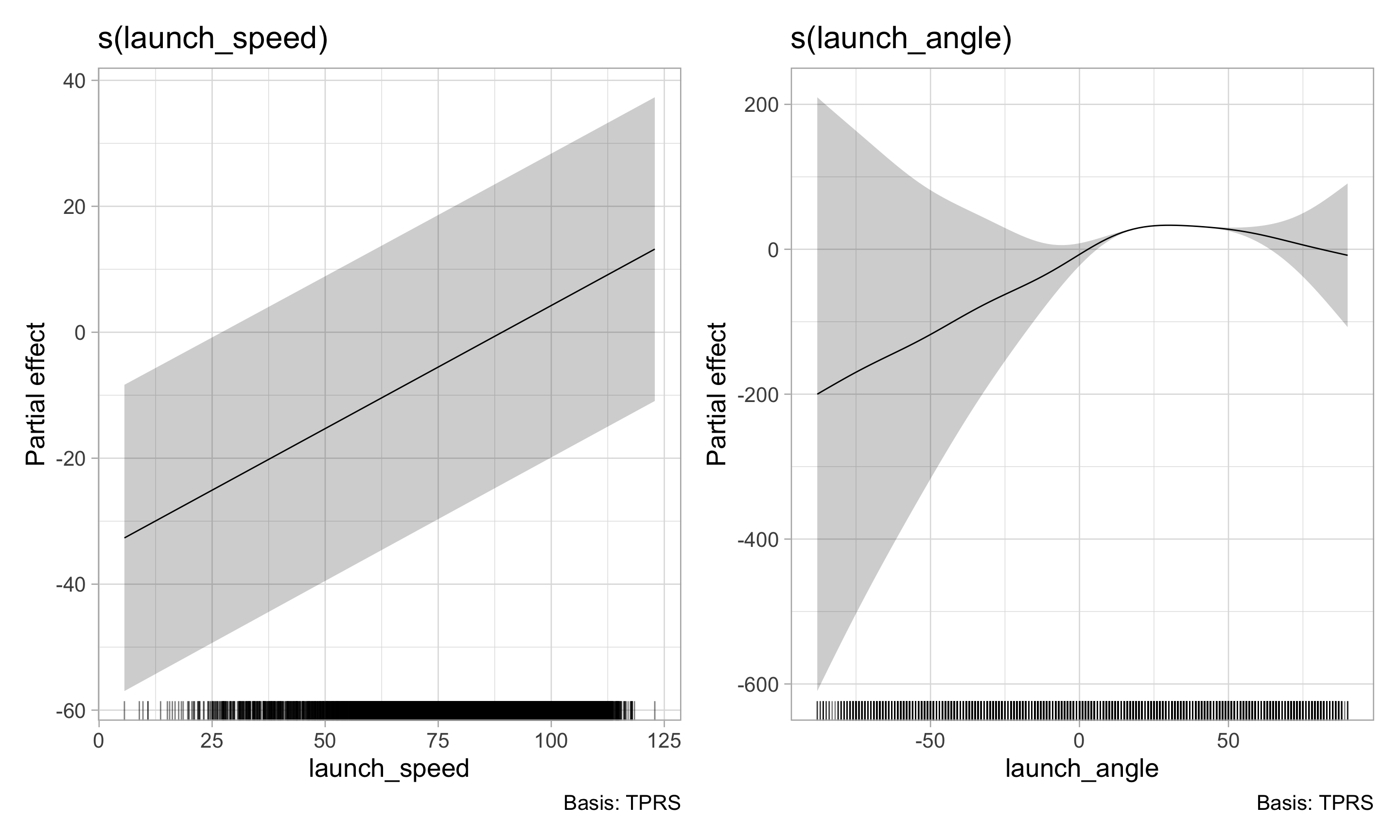
\log \left( \frac{p_{\texttt{is_hr}}}{1 - p_\texttt{is_hr}} \right) = \beta_0 + s_1 (\texttt{launch_speed}) + s_2 (\texttt{launch_angle})\] where \(p_\texttt{is_hr}\) is the probability of a home runmgcv performs hypothesis tests for the smooth terms — these are roughly the equivalent of an \(F\)-test for dropping each term
Effective degrees of freedom (edf): basically the number of free parameters required to represent the function
In a smoothing spline, different choices of \(\lambda\) correspond to different values of the edf, representing different amounts of smoothness
# A tibble: 2 × 5
term edf ref.df statistic p.value
<chr> <dbl> <dbl> <dbl> <dbl>
1 s(launch_speed) 1.00 1.00 804. 0
2 s(launch_angle) 3.73 3.98 468. 0
# A tibble: 1 × 5
term estimate std.error statistic p.value
<chr> <dbl> <dbl> <dbl> <dbl>
1 (Intercept) -38.3 12.3 -3.11 0.00189
Display the partial effect of each term in the model and how they add up to the overall prediction
hr_cv <- function(x) {
hr_train <- batted_balls |> filter(fold != x)
hr_test <- batted_balls |> filter(fold == x)
gam_fit <- gam(is_hr ~ s(launch_speed) + s(launch_angle),
family = binomial,
method = "REML",
data = hr_train)
logit_fit <- glm(is_hr ~ launch_speed + launch_angle,
family = binomial, data = hr_train)
hr_out <- tibble(
gam_pred = predict(gam_fit, newdata = hr_test, type = "response"),
logit_pred = predict(logit_fit, newdata = hr_test, type = "response"),
test_actual = hr_test$is_hr,
test_fold = x
)
return(hr_out)
}
hr_preds <- map(1:N_FOLDS, hr_cv) |>
list_rbind()Very few situations in reality where GLMs (with a linear predictor) perform better than an additive model using smooth functions
Especially since smooth functions can just capture linear models
hr_preds |>
pivot_longer(cols = gam_pred:logit_pred,
names_to = "model",
values_to = "test_pred") |>
mutate(test_pred_class = round(test_pred)) |>
group_by(model, test_fold) |>
summarize(accuracy = mean(test_pred_class == test_actual)) |>
group_by(model) |>
summarize(cv_accuracy = mean(accuracy),
se_accuracy = sd(accuracy) / sqrt(N_FOLDS))# A tibble: 2 × 3
model cv_accuracy se_accuracy
<chr> <dbl> <dbl>
1 gam_pred 0.973 0.00105
2 logit_pred 0.959 0.00148